
Rating in Practice
In the Rating in Practice section, you’ll learn the key rules for assessing Value and Severity. This section shows you exactly what to consider for each dimension, helping you ensure accuracy and depth in your ratings
Rating the Value
The first step after carefully reading the analysis is to make your own judgment about the value of the impact described, which can be positive, neutral, or negative. The range goes from strongly negative (-5) to strongly positive (+5). But not so fast, there are a few rules to keep in mind for a thoughtful assessment:
1. Evaluating the Core Impact
You’re rating the value of the impact described, and nothing else
The first thing is identifying the impact described, and for that, you should look at the topic associated with the analysis you just read. If the topic, for example, is “Operational Water Consumption”, you’re rating the value of the water consumed by the company, and nothing else. This implicates the following:
The majority of topics have clear value polarity, and this refers to whether the impact described is inherently positive or negative. Using the example above, consuming water from natural resources always has a negative environmental impact because it depletes a shared resource, i.e., the nature of the impact described is negative. Therefore, inherently negative topics are never positive in value, and vice versa.
For other topics, like Gender Equality, the value can be positive, neutral, or negative depending on the specific details of the situation described. Your judgment will determine how to assess the impact.
In section 1 it was discussed that mitigation and remediation are responses to an already existing negative impact, and therefore they should not influence your ratings in value. In our example, initiatives like reusing/recycling water or retrieving water from non-stressed sources do not alter the negative impact of Operational Water Consumption. These initiatives could be taken into consideration when rating the severity, but not the value. In other words, corrective actions do not change the nature of the impact.
When assessing the impact of a company’s actions, it’s essential to remember that the completeness of data does not influence the inherent nature of that impact. For instance, if a company does not provide full details about its water consumption, you must still evaluate the impact based on the fact that water consumption is inherently negative. The lack of information regarding the source of the water or whether it is reused or recycled should not affect your judgment of its impact.
Whether a company operates in manufacturing, agriculture, or services, the act of consuming water from natural resources has a consistently negative environmental impact. This depletion of shared resources does not change based on the sector in which the company operates.
2. Value Reflects Impact Type, Not Scale.
The Value doesn’t measure how big or small the impact is for a company.
The significance/materiality of the impact described for a company, or the impact severity, is not measured in Value. Factors such as how deeply the impact affects the environment or people, or its persistence and overall reach should not be taken into consideration when you’re deciding whether the impact is positive, neutral, or negative. For example, when assessing Operational Water Consumption, you should not consider how much or how little water the company used in determining its Value. Instead, Severity accounts for the scale and magnitude of the impact.
3. Evaluate the Impact in Isolation
The Value of one impact described never takes into account other topics for the same company.
This means that when rating the analysis, you must focus only on the topic covered in the specific summary, without considering other impacts of the company discussed in different analyses. Thus, when rating the water consumption of a company, you shouldn’t take into account the company’s GHG emissions or promotion of gender equality in the workplace, for example.
Rating the Severity
After rating the value, you should move on to rating the severity, which is responsible for quantifying the impact materiality of a topic for a company. Severity is divided into three dimensions, which range from 1 to 5: scale, scope, and irremediability. Topics with higher severity—indicating greater weight in these dimensions—are considered more significant and material for the company.
1. Scale: How severe the impact is
Scale pertains to the complexity and depth of the impact described. When assessing scale, consider how profoundly people or the environment are affected and whether the impact brings significant changes to the planet or society. In our Operational Water Consumption case, you should consider how much of the water withdrawn and consumed came from highly stressed areas, for example.
2. Scope: How widespread the impact is
The scope captures the range or extent of the company’s impact and it is related to the quantitative part of the analysis. This relates to how many people or species are affected, or if the impact has a more local or global reach. In our example, you should consider how much water is consumed by the company.
To better inform your scope assessment, refer to the data points at the end of the analysis to see how the company’s water consumption compares to that of others in the Impaakt Universe.
3. Irremediability: How persistent the impact is
Irremediability evaluates the impact of the company over time. In other words, it quantifies the longevity of the impact (days/decades and how reversible, easily stopped, or extended the impact is).
In our example, you could consider aspects such as whether the water consumption patterns of the company are relevantly changing over time or not, and if the water was withdrawn from highly stressed areas. You can also take into account whether the company reuses or recycles the water.
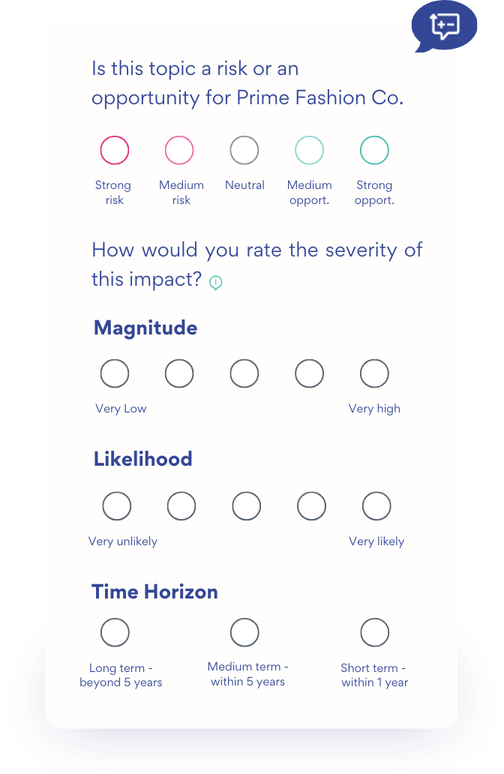
4. For Potential Impacts Only: The Likelihood and TimeFram
When assessing a topic that represents a potential impact for a company rather than an actual one, such as Climate Change Mitigation, you will need to rate both the likelihood of occurrence and the timeframe for the impact. The difference between an actual and potential impact is explored in Section 1.
In this context, ask yourself: how likely is it that the company is effectively mitigating climate change? It ranges from very unlikely to very likely.
Next, you’ll evaluate the time horizon, assessing when the impact is expected to materialize. This ranges from long-term (beyond 5 years) to short-term (within a year). For example, consider the timeframe in which the company’s climate change mitigation efforts will have tangible effects on the planet and society.

Important Notes about Severity
- The Materiality Maps & the importance of good quality ratings
The combined “weights” (or severity) of all topics determine a company’s overall materiality, which you can view in our materiality maps on the website under the “Industries” or “Companies” tab. These graphs compile all companies or industries from the Impaakt Universe for comparison. Each company or industry is represented by a circle, with the size indicating the weight of their impact—larger circles signify greater severity or materiality. The color of the circles also conveys the value of the impact (or the company score), with blue indicating a positive score and pink indicating a negative one.
It’s important to note that the size of the circles does not grow linearly but exponentially, based on the overall materiality derived from your ratings of the three severity dimensions. Specifically, the weight is calculated by multiplying the ratings together and then by 8. For example, if you rate scale, scope, and irremediability as 1, the final weight for that topic will be 8 (1 * 1 * 1 * 8). Conversely, if you rate all three dimensions as 5, the final materiality will be 1,000 (5 * 5 * 5 * 8), which is 125 times more than 8. Understanding this exponential effect is fundamental to grasping how your ratings influence the overall analysis, so it’s important to be thoughtful in your evaluations.